Strategic Resilience in Surface Finishing: Navigating the 2026 Petrochemical Crisis
The global chemical industry is currently facing a structural paradigm shift. With crude oil volatility and the disruption of traditional supply chains, the paint and metal pretreatment sectors are seeing unprecedented pressure on margins. Reliance on traditional petrochemical feedstocks is no longer a sustainable business strategy.
This paper outlines alternative pathways for manufacturers to decouple their operations from petrochemical dependency through formulation innovation and operational lean strategies.
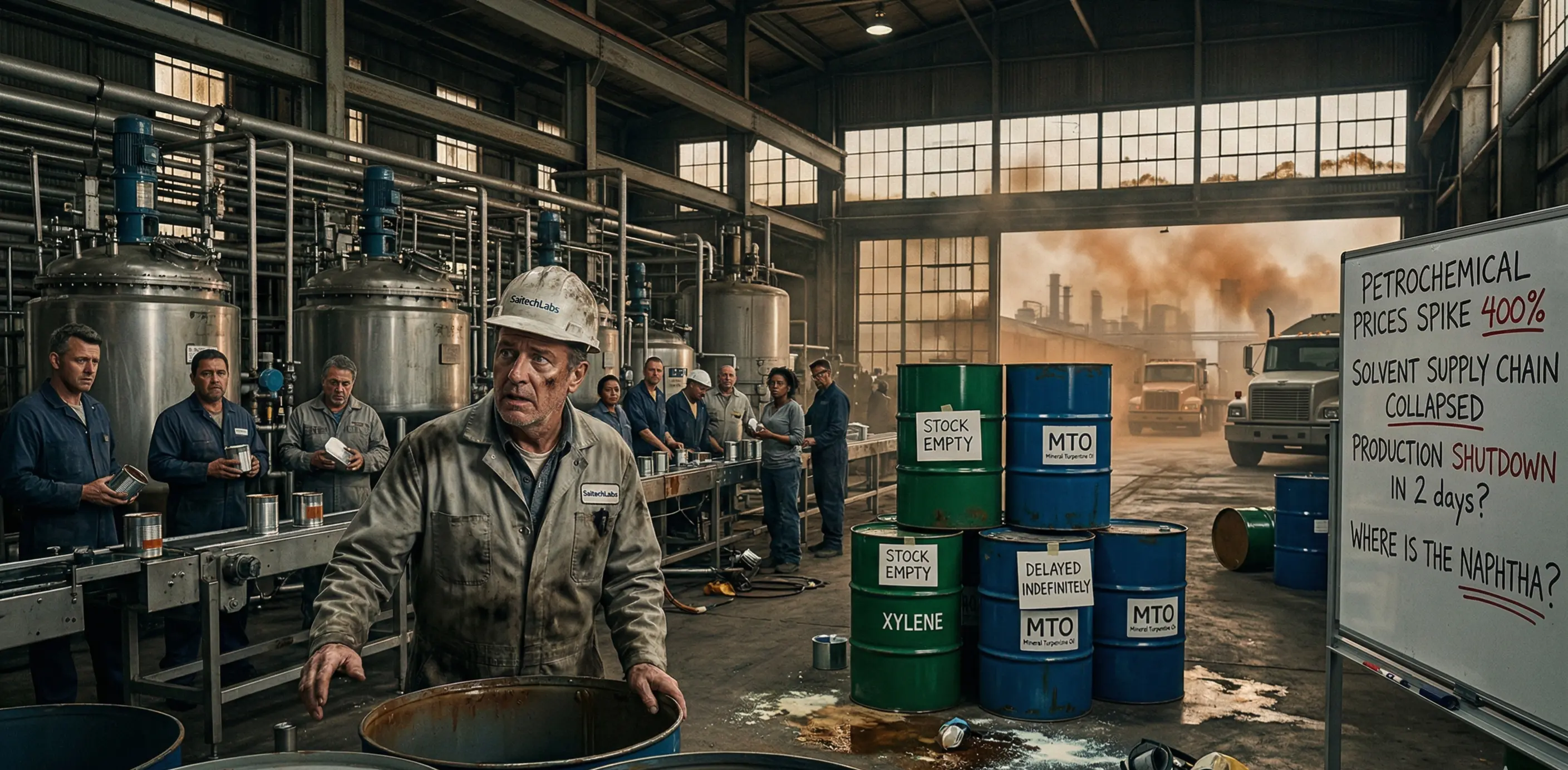
1. Feedstock Decoupling: The Bio-Revolution
The most immediate survival tactic is the integration of bio-based materials into existing formulations. As naphtha-based solvents rise in cost, vegetable-derived alternatives are reaching price parity.
- Bio-Based Resins: Transitioning to alkyds derived from tall oil fatty acids or lignin-based epoxy resins.
- Green Solvents: Substituting Mineral Turpentine Oil (MTO) and Xylene with Bio-Ethanol, Ethyl Lactate, or Methyl Soyate where feasible.
2. Nanotechnology in Pretreatment
Traditional phosphating requires high-temperature baths and heavy petrochemical-based stabilizers. SaitechLabs recommends a pivot to Zirconium-based nanoceramic coatings. These provide superior corrosion resistance while operating at ambient temperatures, drastically reducing energy overheads.
3. The Efficiency Matrix
| Market Segment | Mitigation Strategy | Impact |
|---|---|---|
| Decorative Paints | High-Solid Waterborne Transitions | Reduces VOC & Solvent Tax |
| Industrial Coatings | UV-Curable Systems | Drastic Energy Reduction |
| Metal Pretreatment | Ambient Temperature Degreasing | Lower Fuel Consumption |
4. The "Vintage Technology" Revival
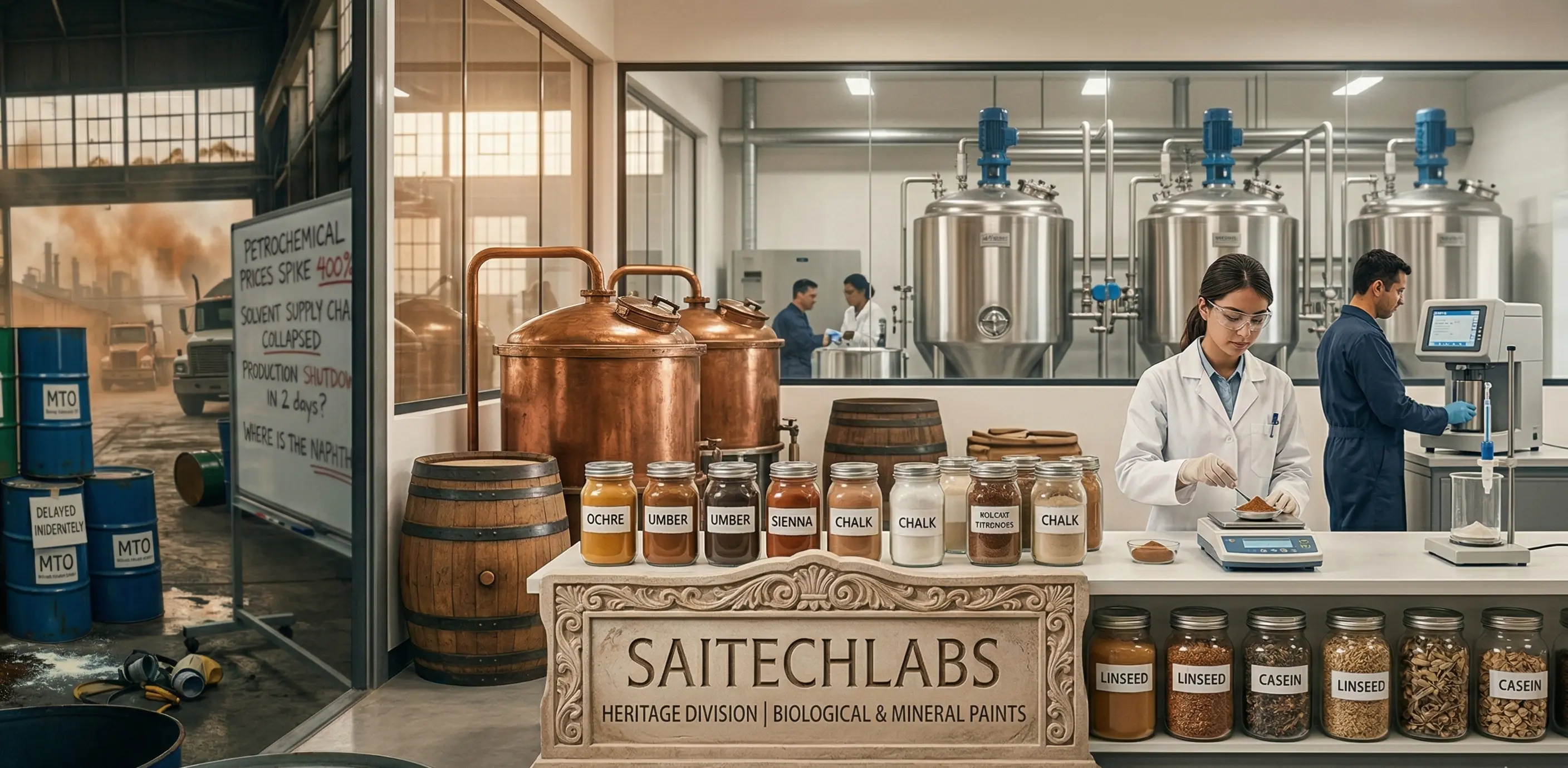
A profound opportunity lies in looking backward to move forward. Just as the fashion industry constantly revisits and reinterprets vintage designs with modern twists, the coatings sector is on the cusp of its own "vintage technology" revival. This strategy involves decoupling *completely* from the petrochemical supply chain by returning to **biological and mineral heritage paints**—technologies that dominated the industry before the mid-20th century petroleum boom.
Strategy 5: The Heritage Pivot
Reviving 19th-Century Materials with 21st-Century Quality Control.The core advantage of biological and mineral heritage technologies is that their supply chains are often completely local, agricultural, or mineral-based, bypassing the geopolitical price fluctuations of crude oil and refinery byproducts like naphtha.
Here is how manufacturers can adapt fashion-forward thinking to chemical coatings by utilizing a heritage feedstock inventory:
| Petrochemical Product | "Vintage" Material (Heritage) | 21st-Century Enhancement |
|---|---|---|
| PVA/Acrylic Emulsions | Casein (Milk Protein), Lime Wash | Nano-emulsified for stability; antimicrobial agents added. |
| Alkyd/PU Resins | Linseed Oil, Tung Oil | UV-curable accelerators; improved drier technology (cobalt-free). |
| Synthetic Pigments | Mineral Earth Pigments (Ochres, Umbers, Siennas) | Micronized milling for uniform particle size and high-opacity. |
| Solvent-borne Coatings | Silicate Paints (Potassium Silicate) | Hybrid organic-silicate binders for easier application. |
Why this works in 2026: The "Retro-Chic" Premium
This is not just a cost-cutting measure; it is a marketing masterstroke. Manufacturers can command a premium price for "100% Zero-Petrochemical" or "Carbon Neutral" lines, tapping into growing demand for sustainable, healthy, and high-breathability paints for historic restoration and green building projects.
5. Digital Lean Manufacturing
In 2026, survival is determined by "First-Time-Right" yield. Utilizing AI-driven batching systems helps in reducing waste. By optimizing the molecular weight distribution in resin synthesis, manufacturers can achieve the same film performance with 15% less material volume.
References & Further Reading
1. The Future of Bio-Based Coating Systems (2025), Journal of Industrial Chemistry.
2. Global Supply Chain Volatility and the Chemical Sector, International Petrochemical Report March 2026.
3. SaitechLabs Technical Dossier on Nanoceramic Passivation, SaitechLabs Documentation Hub.
4. Mineral and Biological Painters' Manual (Reprint, orig. 1891), Association of Heritage Restorers.