
SAITECHLABS
Surface Coating Technology Solutions | Technical Case Study | SaitechAI
Surface Coating Technology Solutions | Technical Case Study | SaitechAI
A troubleshooting case study on instability observed during formulation of an alkaline liquid degreaser, focusing on the likely reasons for layer separation, settling, or haze formation after the addition of sodium polyacrylate, and the practical remedies for restoring batch stability.
| Document Type | Case Study |
| Application | Alkaline Liquid Degreaser |
| Issue | Layer Separation / Settling |
| Prepared By | SaitechLabs |
| Powered By | SaitechAI |
During preparation of a caustic-based alkaline liquid degreaser, the batch remained reasonably uniform until sodium polyacrylate solution was introduced. Immediately after this addition, the product showed layer separation, cloudy instability, or partial settling.
The cleaner contains high alkalinity, builder salts, hydrotrope, surfactant, and sequestrant. Such systems often become sensitive to anionic polymers when ionic strength becomes too high.
This is generally a compatibility problem rather than a simple raw material failure. The polymer may destabilize under concentrated caustic-silicate-salt conditions.
| Raw Material | Quantity (g) | Technical Function |
|---|---|---|
| Water | 64 + 10 | Solvent / medium |
| NaOH 50% solution | 12 | Strong alkalinity / grease saponification |
| Sodium metasilicate | 2.5 | Builder / detergency / support for metal cleaning |
| Sodium gluconate | 3 | Chelation / sequestration |
| Alphox 200 | 6 | Nonionic surfactant for oily soil removal |
| Sodium xylene sulphonate | 1.6 | Hydrotrope / solubilizer |
| Sodium polyacrylate 45% solution | 2 | Dispersant / anti-redeposition / sludge control |
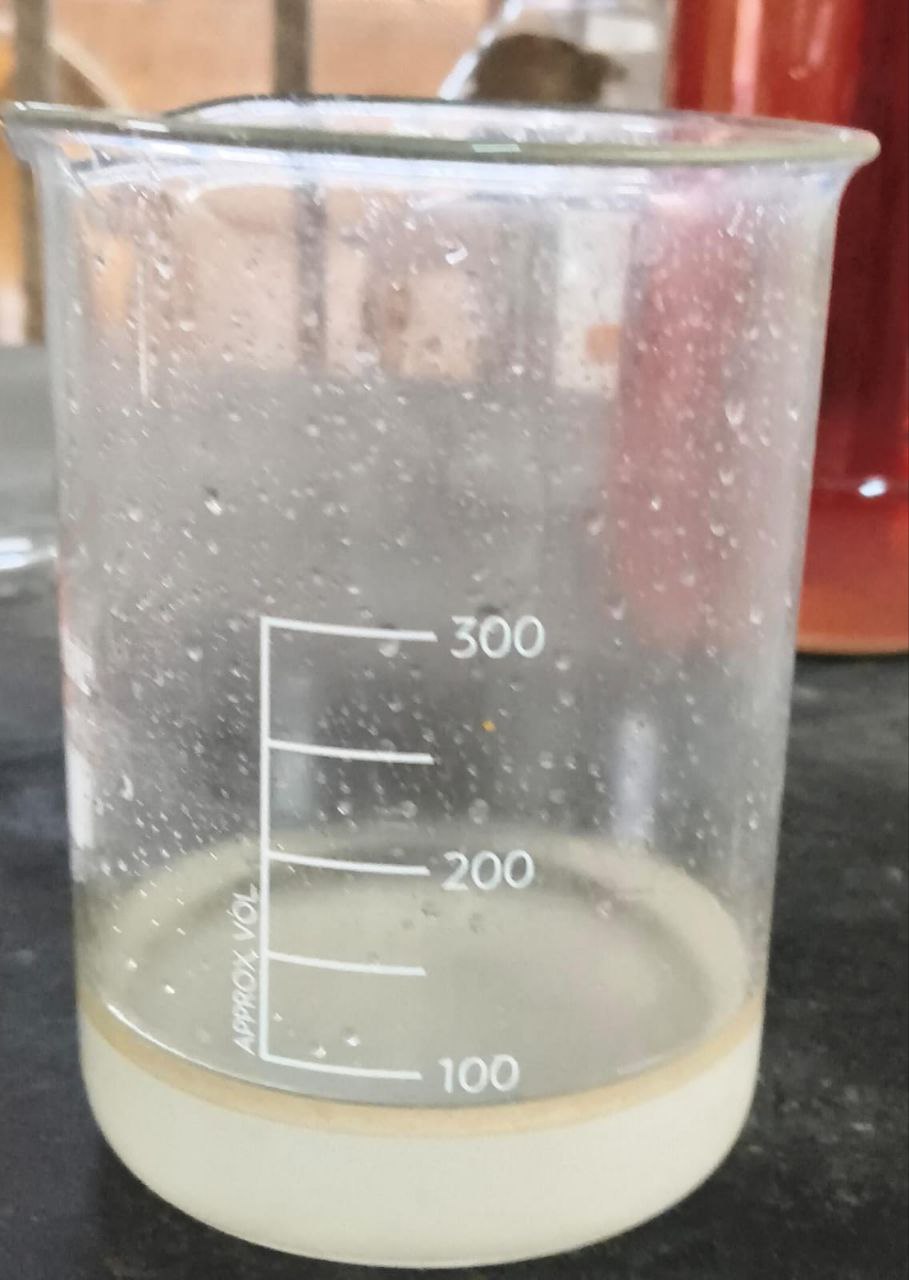
The image may represent top-bottom layer formation, haziness, sedimentation, or partial incompatibility. In such batches, the point of instability is often linked to the polymer-addition stage rather than the earlier surfactant or caustic addition stages.
Water quality must be checked first. Development trials should preferably be carried out with DM or softened water to eliminate hardness-related incompatibility.
Dilute the polymer with 3–5 parts water before addition. This reduces local concentration shock and improves distribution during mixing.
Add the polymer into a milder medium before strong alkali and silicate become highly concentrated in the batch.
If the cleaner performs well without the polyacrylate, the formulation may be more stable by reducing the level or eliminating it completely.
| Trial | Modification | Purpose | Expected Learning |
|---|---|---|---|
| Trial 1 | Use DM water with same formula | Check hardness effect | Confirms whether water quality is the main issue |
| Trial 2 | Change addition sequence | Check process effect | Shows whether instability is sequence-driven |
| Trial 3 | Reduce sodium polyacrylate level | Check dosage sensitivity | Finds the highest stable dosage |
| Trial 4 | Remove sodium polyacrylate | Check necessity of polymer | Shows whether the cleaner can remain stable without it |
| Trial 5 | Use alternate compatible dispersant | Improve formulation robustness | Helps identify a better anti-redeposition package |
The alkaline liquid degreaser formula is fundamentally workable, but sodium polyacrylate becomes the unstable point in the present concentrated system. The observed layer separation is most likely due to the combined effect of high ionic strength, strong caustic environment, silicate presence, possible water hardness, and/or unsuitable polymer grade.
The most practical remedies are:
For formulation troubleshooting, cleaner stability improvement, raw material compatibility study, or plant-level validation support, contact SaitechLabs.
WhatsApp: 9444929163
Open WhatsApp Consultation